Virtual CTO: what the role covers and when you need one
What a virtual CTO does, how it differs from a fractional or interim CTO, the signs you need one, what the first 90 days should deliver and how to choose one.
Asghar Ali · Chief Technology Officer, Kakushin.io LTD
A virtual CTO is a senior technology leader who works for your company part-time and mostly remotely, and owns the decisions a full-time CTO would own: the architecture, the engineering team, how software gets released, security, and what the company spends on technology. You buy a fixed share of their time each month instead of a full-time salary, and you get the judgement before you can justify the hire.
That is the short answer. You need one when technology decisions are shaping the company's future but there isn't yet enough work, or money, for a full-time CTO. The usual cases are a non-technical founder working with an agency or freelancers, a startup between its first build and its first engineering hires, and a company whose CTO has just left. I take part-time CTO engagements alongside my full-time role, so this essay is the view from inside the job: what it should cover, what it shouldn't, and how to tell whether you need it at all.
What is a virtual CTO?
A virtual CTO is an outside technology executive who holds the CTO's responsibilities for a company on a part-time, usually remote, basis. "Virtual" refers to the remote, time-shared arrangement, not to a lesser role: the decisions and the accountability are the same as a full-time CTO's, spread over fewer hours.
Two quite different jobs share the name, and it helps to know which one you are being offered:
| Virtual CTO for a company that builds software | "vCTO" from a managed IT provider | |
|---|---|---|
| Who it's for | Startups and scale-ups whose product is software | Small businesses whose IT supports the business: laptops, Microsoft 365, networks, backups |
| What it covers | Product architecture, the engineering team, releases, security of the product, technology budget | IT strategy, hardware and licence refresh cycles, cyber insurance requirements, quarterly reviews |
| Usually sold | On its own, as a retainer | As part of a managed-services contract |
| The watch-out | The person must be independent of whoever writes the code | The adviser may also be selling you the provider's services |
The second is a legitimate service, closer to a virtual CIO: it is the same line that separates a CTO, who looks after the product's technology, from a CIO, who looks after the technology the business runs on. This essay is about the first.
Virtual CTO vs fractional, interim and CTO-as-a-service
In practice "virtual CTO" and "fractional CTO" describe the same arrangement: an experienced CTO for a fraction of the week. The other labels differ in length and commitment.
| Model | Time | Length | Accountability | Fits when |
|---|---|---|---|---|
| Virtual / fractional CTO | A fixed number of hours or days a month | Ongoing, often a year or more | Owns technical decisions and reports to the founders or board | Decisions arrive every week, but not enough for a full-time role |
| Interim CTO | Full-time or close to it | A few months | Runs the function while a permanent CTO is hired | The CTO has left, or a crisis needs someone in the chair every day |
| CTO-as-a-service | A defined package | A fixed scope: a review, a plan, a vendor selection | Delivers the package, then leaves | One question needs an answer, not ongoing ownership |
| Technical consultant | As needed | Project by project | Advises; the company decides and owns the outcome | You have the leadership and need specialist depth |
If you only have one question, such as "is the code our agency delivered any good?", you don't need a CTO of any kind. You need a source code audit. If you have a new question every week, you need someone who owns the answers.
What does a virtual CTO actually do?
A virtual CTO is responsible for seven areas, and for each one you should end up with something written down that the company keeps when the engagement ends.
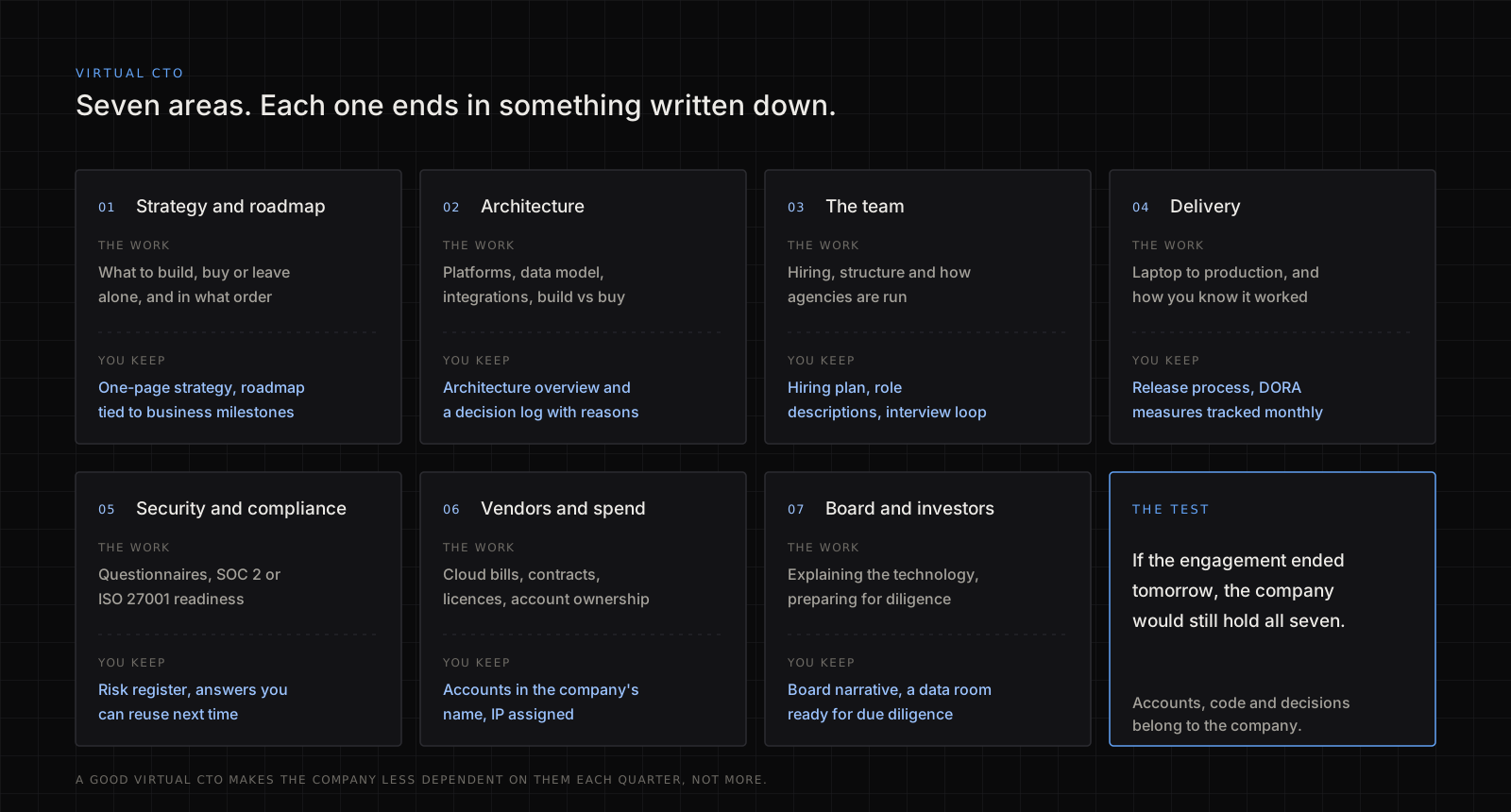
| Area | What the work is | What you should be able to hold after a quarter |
|---|---|---|
| Strategy and roadmap | Turning the business plan into a technical plan: what to build, buy or leave alone, and in what order | A one-page technology strategy and a roadmap tied to business milestones |
| Architecture | The decisions that are expensive to reverse: platforms, data model, integrations, build vs buy | A short architecture overview and a log of key decisions with the reasons |
| The team | Hiring, structure, the first engineering manager, how agencies and contractors are run | A hiring plan, role descriptions, an interview process |
| Delivery | How code goes from a laptop to production, and how you know it worked | A written release process and the delivery measures tracked monthly |
| Security and compliance | The product's security, customer security questionnaires, SOC 2 or ISO 27001 readiness, data protection | A risk register, the top fixes done, answers you can reuse for the next questionnaire |
| Vendors and spend | Cloud bills, agency contracts, licences, who owns the code and the accounts | Every critical account owned by the company, a cloud cost baseline, contracts with IP assignment |
| Board and investors | Explaining the technology, preparing for due diligence | A technical narrative for the board, a data room that would survive technical due diligence |
The delivery measures I use are DORA's. The original "four keys" were deployment frequency, lead time for changes, change failure rate and time to restore service; DORA's current guide lists five: change lead time, deployment frequency, failed deployment recovery time, change fail rate and deployment rework rate. They are not perfect, but they turn "is the team getting faster?" from a feeling into a number.
Security is the area most often left until a customer asks. A large customer's security questionnaire or a request for a SOC 2 report (the examination is defined in the AICPA's SOC 2 guide) is frequently the event that makes a company look for a CTO at all. The baseline I hold a product to is the one in the application security list I enforce.
What a virtual CTO should not be
A good virtual CTO makes the company less dependent on them over time, not more. Four arrangements to avoid:
- The only person who can deploy. If production access, the cloud root account or the domain registrar sits with the CTO personally, the company has swapped one risk for another. Those accounts belong to the company.
- The main developer. A part-time CTO who writes most of the code has no time left for the decisions you hired them for. Hands-on is good; being the bottleneck is not.
- Reviewing their own firm's work. If your virtual CTO's company also builds your product, nobody independent is checking the build. Keep the roles apart, or at least know that they aren't.
- A name on the pitch deck. An adviser with a title and no hours is not a CTO. Investors notice, usually during due diligence.
When do you need a virtual CTO?
You need one when technology decisions with long consequences keep arriving and nobody inside the company is qualified to own them. These six situations are the common ones:
- A non-technical founder is paying an agency or freelancers and can't judge the quotes, the estimates or the quality of what comes back.
- The first version exists and the first hires are next. Someone has to decide what kind of engineers to hire, how to interview them and how they will work.
- The CTO or lead developer has left, and the knowledge left with them.
- A fundraise or an acquisition is coming, and the technology has to survive an investor's or buyer's review.
- A large customer is asking for security evidence: a questionnaire, a penetration test report, SOC 2.
- A big technical decision is due: a platform migration, a legacy modernisation, a rebuild an agency is recommending, or a vendor contract worth more than a year of salaries.
If two or more of these are true at once, the cost of a wrong decision is usually higher than the cost of a part-time CTO.
When you don't need one
Not every company with software needs a CTO, virtual or otherwise.
- Your technology supports the business but isn't the product. An accounting firm or a clinic usually needs a good managed IT provider, not a CTO.
- You need more building capacity, not more judgement. If the decisions are clear and the work is just behind, hire engineers.
- You have one question. Buy a review with a fixed scope: an audit, a due diligence, a second opinion on a quote.
- You already need a full-time CTO. When decisions arrive daily, the team has grown into several groups the CTO can no longer know personally, or the product's technology is the main thing investors are buying, a part-time arrangement starts to slow you down. That is the time to hire a full-time CTO, and a good virtual CTO will tell you so and help with the search.
How a virtual CTO engagement works
Most engagements are a monthly retainer for a fixed amount of time, with a regular rhythm the founders can rely on. A typical shape:
- A weekly call with the founders to make decisions, not just report.
- A seat in the leadership meeting, in person or remotely.
- Asynchronous review of architecture decisions, pull requests on critical paths and vendor proposals between calls.
- A short written report each month: what was decided, what changed in the measures, the top risks and what is next.
- An agreed escalation path for incidents, so everyone knows whether the CTO is on call and for what.
The contract should cover an NDA, assignment of any intellectual property to the company, notice on both sides, and a statement of any supplier relationships the CTO has. Access should be read access by default, granted by the company, and removable on the last day.
What the first 90 days should deliver
The first 90 days of a virtual CTO engagement should move from reading, to deciding, to running. If a quarter passes without written outputs, something is wrong.
| Days | Focus | Outputs |
|---|---|---|
| 1–30: read | The code, the cloud account and bill, who has access to what, the contracts, the team and how it ships | A written assessment and the top five risks, ranked |
| 31–60: decide | The roadmap, the architecture decisions that are overdue, the hiring plan, the release process | A technology strategy, a decision log, role descriptions |
| 61–90: run | Delivery measures in place, the first security fixes done, interviews under way, documentation that removes single points of failure | A baseline for the DORA measures, a risk register, a handover pack that would survive the CTO leaving |
The first month is close to the reading I do for a source code audit: the size and churn of the code, who changes what, which paths carry money and personal data, and whether a clean machine can build it. The difference is that the virtual CTO then stays to act on it.
A worked example
Here is how the first quarter might run for a typical case. It is a composite of common situations, not any one company.
The situation: a seed-stage company sells scheduling software to clinics. The two founders are not technical. An outside agency built the product and still maintains it. The first large customer has sent a long security questionnaire, and the cloud bill is growing faster than revenue.
| Month | What the virtual CTO does | What the founders get |
|---|---|---|
| 1 | Moves the cloud, code and domain accounts into company ownership; reads the code and the agency contract; checks who can reach patient data | An assessment: the product is sound, but the agency holds every admin account and the contract has no IP assignment |
| 2 | Answers the questionnaire honestly, fixes the gaps it exposes (multi-factor authentication for staff, audit logs, backups tested), right-sizes the cloud setup, renegotiates the agency contract | A questionnaire the customer accepts, a reusable security pack, a lower and predictable cloud bill, a contract with IP assignment |
| 3 | Writes the hiring plan for the first in-house engineer, sets up a release process and the delivery measures, plans the handover from agency to in-house team | A role description and interview loop, a release checklist, monthly measures, a six-month roadmap |
The founders did not need a full-time CTO in that quarter, and couldn't yet afford one. They needed someone to own those decisions for a few days a month, and to leave them owning their own company's technology.
How much does a virtual CTO cost compared with a full-time CTO?
A virtual CTO costs a fraction of a full-time CTO because you buy a fraction of the time. In the United States, the median annual wage for computer and information systems managers, the Bureau of Labor Statistics occupation that lists chief technology officer among its titles, was $175,140 in May 2025 (BLS Occupational Outlook Handbook). That is the median for the whole occupation, before bonus, equity, benefits and recruiting fees; startup CTOs with equity are paid very differently.
Virtual CTOs are usually priced as a monthly retainer for a set number of days, sometimes as a day rate, and occasionally as a fixed-price package for a defined piece of work. The main drivers are the time committed each month, how much of it has to be live (meetings, on-call) rather than written review, and whether the work includes hiring or due diligence with a deadline. Compare offers on what you will hold in writing at the end of the quarter, not on the hourly figure.
The cheaper comparison is usually not the salary. It is the cost of the decision made without one: the rebuild nobody needed, the agency contract that kept the code, the customer lost at the security review.
How to choose a virtual CTO
Ask questions that reveal whether they have owned systems, not just advised on them:
- What have you run in production, and what went wrong? You want someone who has been woken by an outage and can describe what they changed afterwards.
- Do you sell development, hosting or software as well? If yes, how do they keep advice and sales apart?
- What will I have in writing after 90 days? Expect a list close to the one above.
- How do you hand over? A good answer includes documentation, account ownership and helping hire a successor.
- How much time is actually mine? Hours or days a month, response times, and what happens in an incident.
- Can I speak to a founder you've worked with? References matter more here than in most hires.
- Will you sign an NDA and assign IP to the company? The answer should be yes before you share anything.
FAQ
What does a virtual CTO do?
A virtual CTO owns a company's technology decisions part-time: strategy and roadmap, architecture, hiring and running the engineering team, the release process, product security and compliance, vendors and technology spend, and explaining the technology to the board and investors. They should leave written outputs the company keeps.
What is the difference between a virtual CTO and a fractional CTO?
Usually none. Both are an experienced CTO working a fraction of the week for one company. "Virtual" stresses that the work is remote; "fractional" stresses the share of time. Managed IT providers also use "vCTO" for an IT-strategy role bundled with their services, which is a different job.
When should a startup hire a virtual CTO?
When technology decisions with long consequences keep arriving and nobody inside can own them: a non-technical founder working with an agency, the first engineering hires approaching, a CTO who has left, a fundraise or due diligence ahead, or a large customer asking for security evidence.
Is a virtual CTO worth it for a non-technical founder?
Usually, if software is the product and an agency or freelancers are building it. A virtual CTO can judge quotes and quality, make sure the company owns its code and accounts, and answer customer security questions. If you only need one answer, a fixed-scope review is cheaper.
Can a virtual CTO become a full-time CTO?
Sometimes, but the more useful outcome is that they help you hire one. When decisions arrive daily or the team grows into several groups, a part-time CTO becomes a bottleneck. A good one plans the hand-over: the role description, the interview process and the documentation.
If you need one
Part-time CTO work is one of the engagements on my hire page: a fixed number of hours a month for architecture, hiring, the release process and the decisions around them, without the cost of a full-time hire.