Prototype · November 2026
A recruitment desk for the trading sector: answer the flood, screen honestly, and put the right person in the right role.
Built from how a senior Dubai recruiter described his own process: an inbox that never empties, knock-out questions stacked two at a time, a pool left to fill for two or three weeks, the right channel for each kind of role, warm candidates who built some ground before asking, and clients who take weeks to answer. RightRole is a working prototype of the desk an agency hiring for prop-trading firms would sit at. It runs in your browser on an invented agency and client, and the guided run performs every step as it explains it.

The problem
Six things that go wrong between a job post and a hire.
The flood
Hundreds of messages a week, many of them “please find attached my resume” with nothing attached, no role named and a subject that says “job”. One recruiter counted more than 30,000 inbox messages in two years.
Calling too early
A post collects applications for two to three weeks. Calling on day one means choosing from the first fifteen, and an unsponsored post stops taking applications at its cap.
One filter is not a filter
Three years in the field and six overall are two different facts. Screen on either alone and the wrong CVs come through; screen on both and the pile is honest.
The wrong role
People apply for whatever is open. Hired into the wrong role on lower pay, they leave inside a year and the client hires again. Retention matters more than recruitment.
Cold asks
“Please refer me” on the day of connecting goes nowhere. The people who get referred built some ground first: useful comments, a question, a few chats over weeks.
Silence
Clients in the UAE often take weeks or months to decide, and candidates hear nothing in between. A visit visa runs out while they wait.
What it does
A desk that reads, screens, waits and follows up.
The system reads and proposes. A consultant decides what is sent, who goes to the client and who is moved to another role.
Read the flood, answer it.
Every email and LinkedIn message is read against the post it answers: no CV, no portfolio link, the wrong subject, a 600-word chatbot letter. The facts are pulled onto one card, and a two-line reply is drafted that asks for exactly what is missing.
Knock-out questions, stacked.
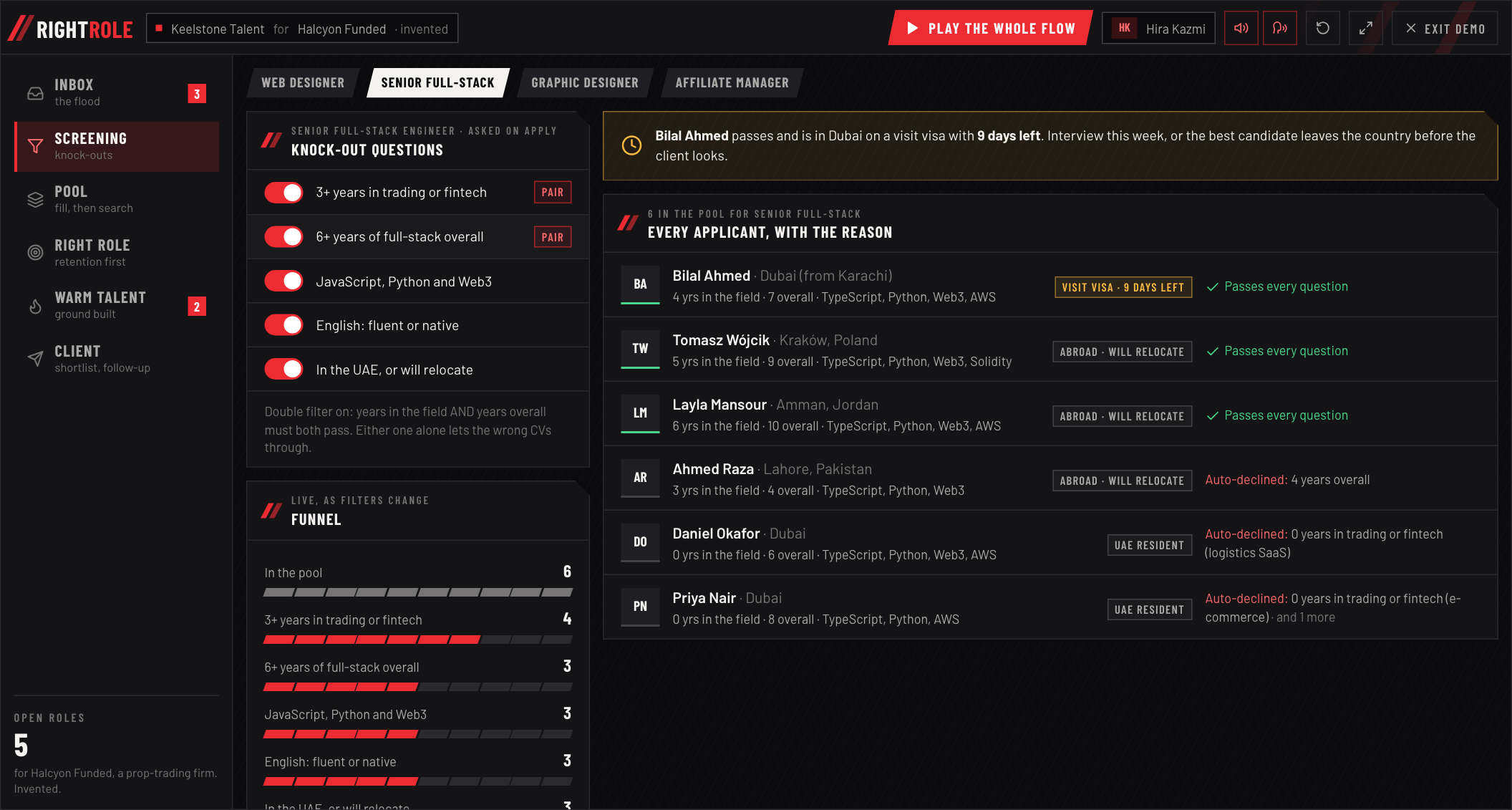
Asked when someone applies and checked by the system: years in the field AND years overall, the stack the client calls a deal-breaker, English, location. Every auto-decline carries its reason, and the funnel shows the effect of each question as it is switched on.
A visit visa is a clock.
A candidate who passes and is in Dubai on a visit visa with nine days left goes to the top, with an interview to arrange this week.
Let the pool fill, then search it forever.
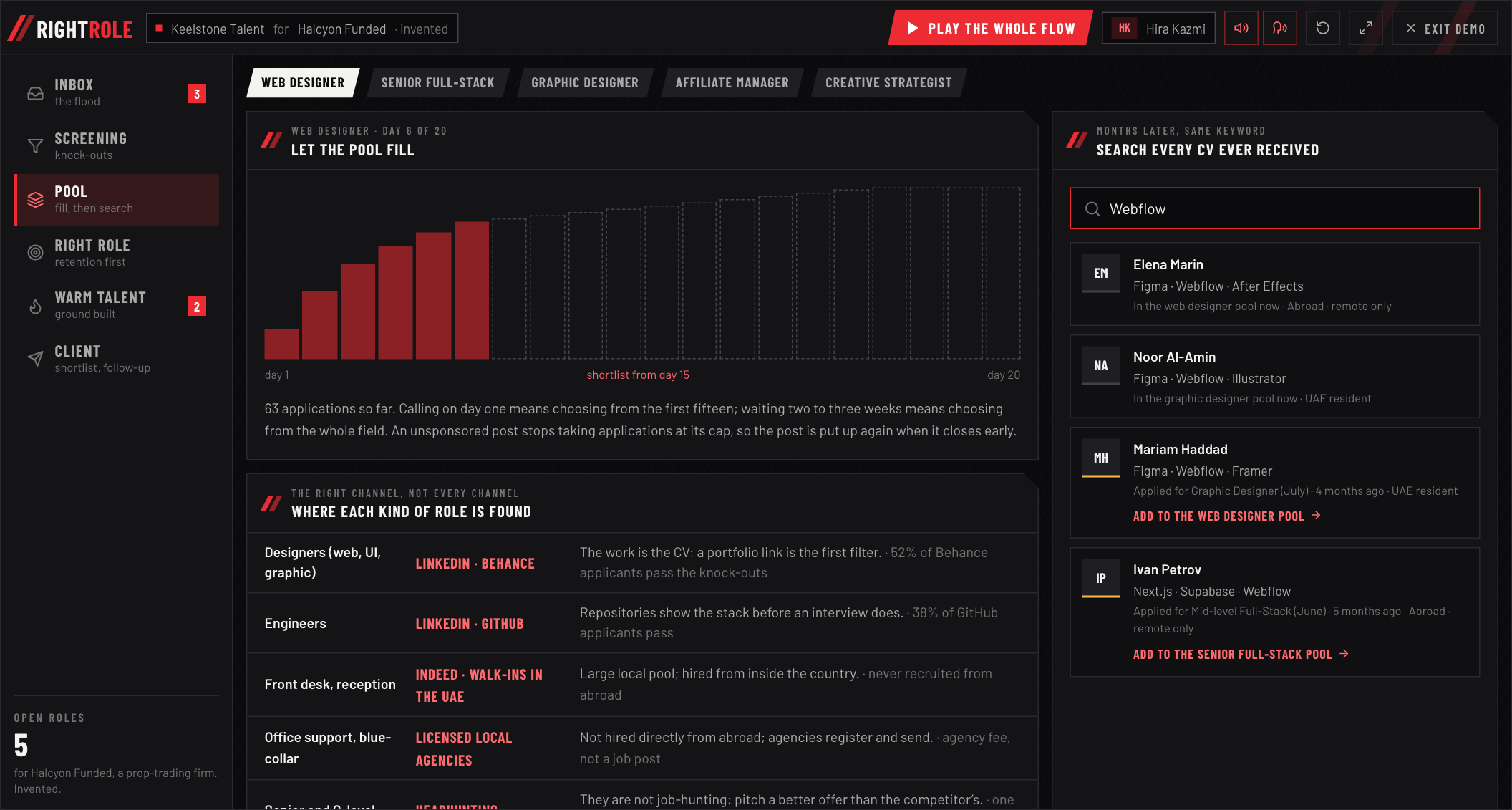
Each post has a window, with the shortlist starting around day fifteen. Every CV ever received stays searchable, so the designer who did not fit in July comes back when the right role opens.
The right channel per role.
Designers from LinkedIn and Behance, engineers from LinkedIn and GitHub, reception from Indeed inside the UAE, office support through licensed agencies, senior people by headhunting.
Right person, right role.
What someone applied for is compared with what they say they want. A graphic designer who wants landing pages is moved to the web designer role, and a retention score shows how likely each placement is to last a year.
Warm talent first.
People who engaged over weeks are marked warm and invited to the role that fits them. A cold referral ask gets a helpful answer that points to the right post instead.
A shortlist, then UAE time.
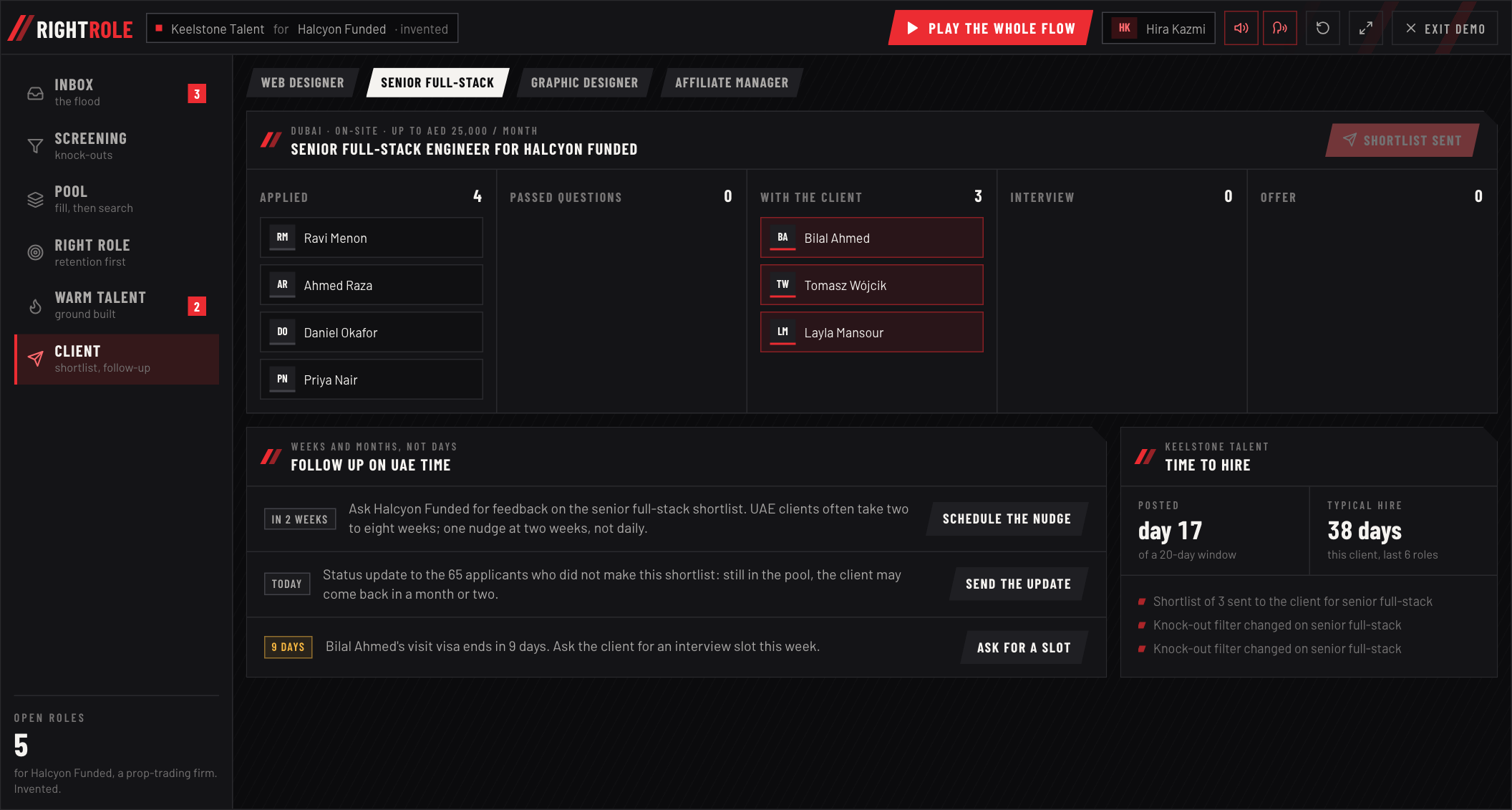
The candidates who pass go to the client together. The client is nudged at two weeks, the rest of the pool gets a status update instead of silence, and the time to hire is tracked.
The guided run
One morning on the desk, in twenty-three steps.
Press play and the walkthrough does each step for real — a genuine click on the control — while a recorded narrator reads it aloud. You can pause, go back, or take over at any point.
01 · 9 steps
The flood
A message with nothing attached, a designer with no portfolio link, a 612-word letter, a complete application — each read, flagged and answered or added to the pool.
02 · 4 steps
Screening
Two filters on years switched on as a pair, the auto-declines with their reasons, and the visit-visa clock.
03 · 4 steps
The pool
Six days into a twenty-day window, a keyword search that brings back a CV from July, and where each kind of role is found.
04 · 2 steps
Right role
A graphic designer who wants web work moved to the role that fits, and the retention score going up.
05 · 2 steps
Warm talent
A contact who built ground over nine weeks invited to apply, next to a cold referral ask.
06 · 2 steps
The client
Three candidates to the prop-trading firm, and follow-ups set for weeks, not days.

Architecture
How it would be built.
Mailbox and LinkedIn in
The agency’s own mailbox and the job-post applications, read through the providers’ approved access. Nothing is scraped, and nothing is sent without a person pressing send.
CVs into fields
A language model reads each CV and message into the same fields the knock-out questions use: years in the field, years overall, tools, location and visa, portfolio. A person can always see the original.
Questions as configuration
Knock-out questions are set per role by the consultant, with the client’s deal-breakers marked. Every auto-decline stores which question it failed.
On top of the ATS
Built to sit beside the agency’s ATS or HRIS (Zoho Recruit and the like): candidates, stages and notes sync both ways, and the search index covers every CV the agency holds.
Consent and retention
Candidates are told their CV stays in the pool and for how long, can ask for it to be deleted, and old CVs expire on schedule, in line with UAE data-protection law.
Scope
What this is, and what it is not.
- It is a prototype built from how a senior Dubai recruiter described his hiring process in a public interview, not a deployed or commissioned system, and it is not affiliated with any recruitment agency, job board or trading firm.
- Keelstone Talent and Halcyon Funded are invented. Every candidate, message, salary, visa and date in the demo is fictional.
- It holds no data: state lives in the visitor’s browser and never leaves it. Nothing is sent to anyone.
- The reply drafts and parsed CV fields in the demo are pre-written for the scenario; in a real build a language model would produce them and a consultant would review them.