Prototype · October 2026 · Pakistan passport
Apply for a Pakistani passport from home: eight counters, one phone.
Getting a passport in Pakistan still means a day at a passport office: a queue outside, a token, then a counter for the photograph, one for fingerprints, one for data entry, a check against the Exit Control List, an interview, a payment, and a second visit to collect. Every one of those steps checks something a phone can already capture or a database already knows. Ghar Se Passport is a working prototype of the whole journey done from home — with the real camera, a real liveness check and a real signature pad — and of the office console where an officer approves it.
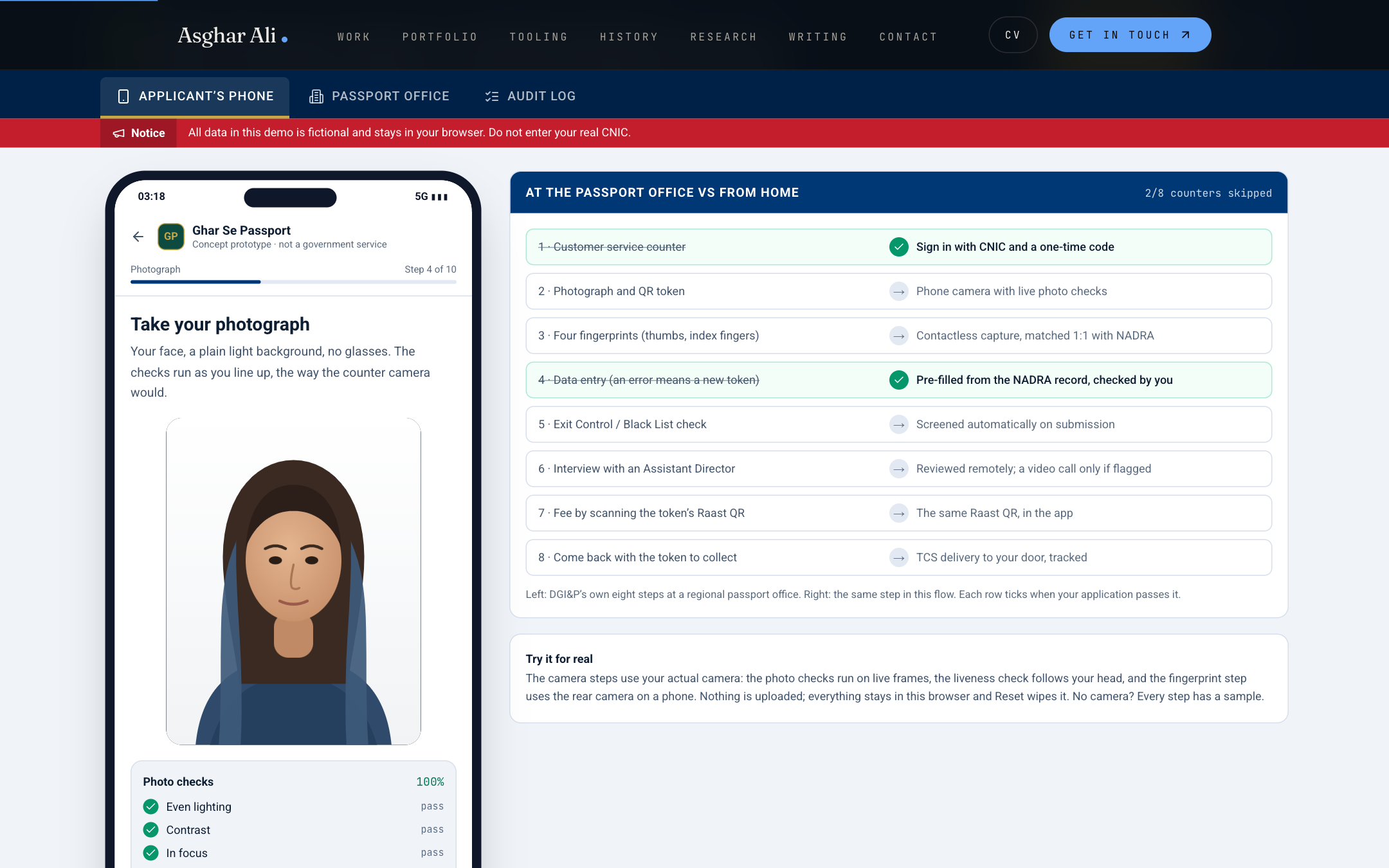
Today
How to apply for a passport in Pakistan today: the eight steps.
DGI&P’s own description of what happens at a regional passport office, in order.
Customer service counter
From home: sign in with CNIC and a one-time code.
Photograph and QR token
From home: phone camera with live photo checks.
Four fingerprints (thumbs, index fingers)
From home: contactless capture, matched 1:1 with NADRA.
Data entry (an error means a new token)
From home: pre-filled from the NADRA record, checked by you.
Exit Control / Black List check
From home: screened automatically on submission.
Interview with an Assistant Director
From home: reviewed remotely; a video call only if flagged.
Fee by scanning the token’s Raast QR
From home: the same Raast QR, in the app.
Come back with the token to collect
From home: tCS delivery to your door, tracked.
Offices open 08:00–16:00, with some in Lahore, Karachi and NADRA mega-centres open around the clock and eight regional offices open until midnight since August 2026. The queue is the problem everyone sees: in August 2026 the Interior Minister removed the officer in charge at Lahore’s Garden Town office after applicants reported waits of nearly four hours and agents charging to get them through. Behind the queue is a capacity problem: in October 2024 the department was receiving 45–50 thousand applications a day against printing capacity of about 20–22 thousand, before new printers doubled output and the backlog was declared cleared that December.
A lot has already moved. Fees are cashless and paid by Raast QR. Home delivery by TCS started in July 2026. Online renewal exists, and since December 2025 fingerprints for it can be confirmed through NADRA’s Pak ID app. And from 15 October 2026 every new passport is an e-passport. What is missing is the joining-up: a first passport still needs a visit, and every visit still walks the same eight counters.
Fees
Passport fee in Pakistan, 2026 (e-passport).
DGI&P’s published e-passport schedule. Machine-readable passports stopped being issued on 15 October 2026; existing ones stay valid until they expire.
| Booklet | Validity | Normal | Urgent |
|---|---|---|---|
| 36 pages | 5 years | Rs 9,000 | Rs 15,000 |
| 36 pages | 10 years | Rs 13,500 | Rs 22,500 |
| 72 pages | 5 years | Rs 16,500 | Rs 27,000 |
| 72 pages | 10 years | Rs 24,750 | Rs 40,500 |
Paid by Raast QR only. Check dgip.gov.pk before paying: fees change, and this page is not an official source.
From home
What each counter becomes.
The prototype keeps every check the office makes. It changes where the applicant is when it happens.
Sign in, no token.
CNIC plus a one-time code to the SIM registered against it. The queue outside and the customer service counter are gone.
NADRA fills the form.
Name, parentage, date and place of birth and address come from the record NADRA already verified. Nobody retypes them, so the data-entry error that sends people back for a new token cannot happen.
The camera is the photo counter.
An oval guide and live checks for light, focus, background and framing. A photo that will be rejected is caught before it is taken, not at the counter.
Liveness, not a selfie.
A random head-turn challenge proves a live person is holding the phone, the way the Pak ID app already uses face recognition.
Fingerprints without a scanner.
The four prints the office takes — both index fingers and both thumbs — captured contactless with the rear camera and matched 1:1 against the prints NADRA holds. Since December 2025 the online channel already confirms fingerprints through Pak ID; this makes the capture part of the same flow.
The same Raast QR, on the phone.
Fees are already Raast-only. The QR comes to the applicant instead of being printed on a token, and the payment reconciles itself against the voucher.
An officer still decides.
Exit Control List and Black List screening and the other checks run on submission. The Assistant Director sees a queue where most files arrive with everything passed, and spends their time on the few that are flagged — with a video interview where a face-to-face one would have been needed.
TCS to the door.
Home delivery already exists since July 2026. With the application made from home too, the applicant never visits an office at either end.
The office
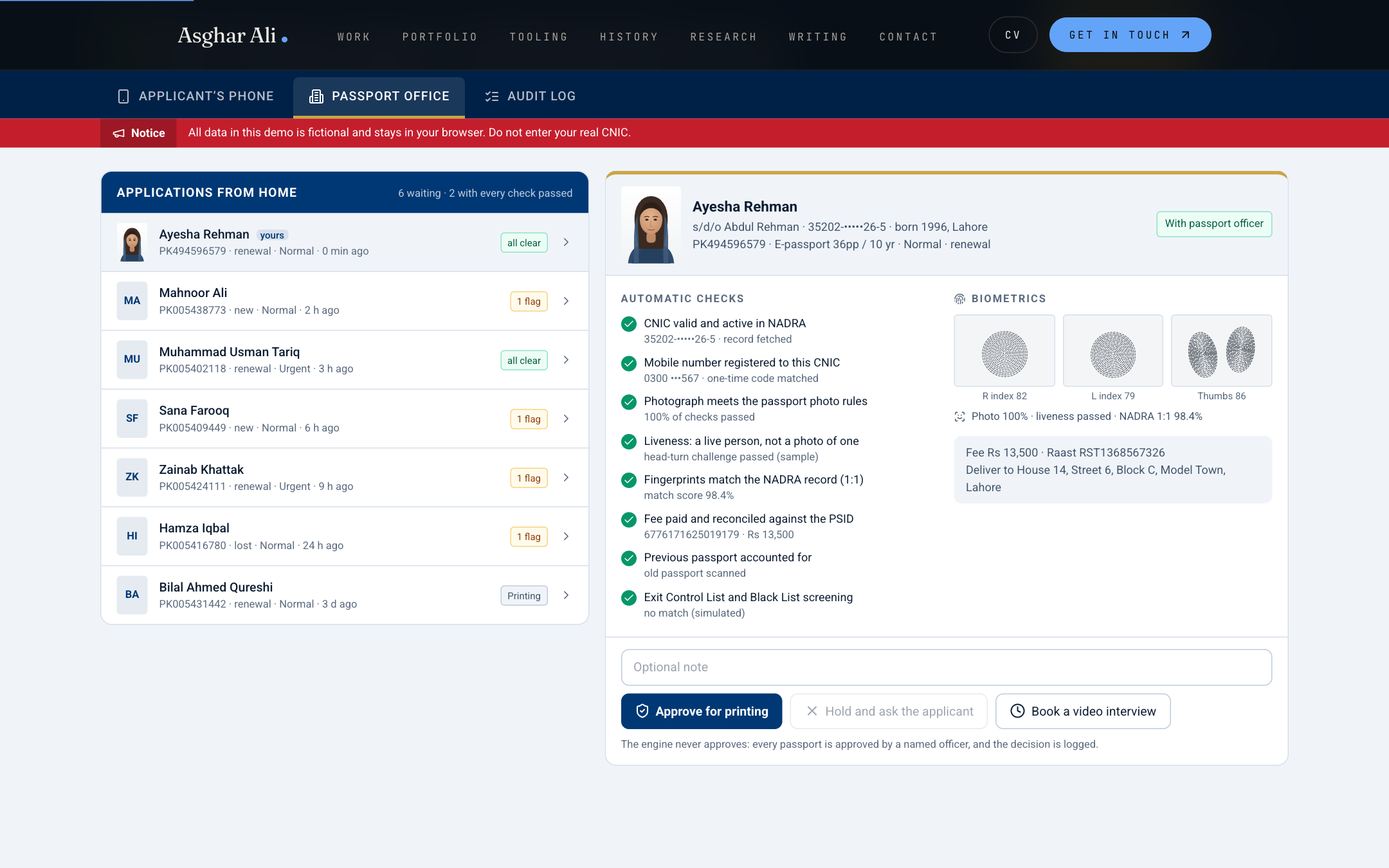
The officer’s screen: decide, don’t re-check.
Every application from home lands in one queue with the checks already done and the evidence attached. The officer’s time goes to the flagged few.
Guardrails
What it would take to run this for real.
- Biometrics stay NADRA’s. The phone sends templates for a 1:1 match against the record NADRA already holds; the passport system never builds its own fingerprint store.
- Contactless fingerprint capture has to be tested against NADRA’s matcher before anyone relies on it. Where quality is low, the file is flagged for a recapture or an office visit — the office stays the fallback, not the default.
- Children, lost passports and anything touching the Exit Control List always go to a person. The prototype flags them; it does not try to decide them.
- Liveness and photo checks would use certified models and the ICAO 9303 photo rules. The prototype’s checks are simple image statistics, good enough to show the flow.
- Every action is logged with who and when, and the log is read-only for everyone, officers included.
Pilot
Ninety days, one passport office, renewals first.
Baseline
Measure today’s time from arrival to submission, rejection reasons at each counter and how many visits an application takes, at one regional office.
Connect
Sign-in and record fetch through NADRA, the Raast fee, and the officer console over the existing passport system, for renewals only.
Pilot
Invite renewal applicants of that office to apply from home; run contactless capture side by side with the office scanner to measure match rates.
Decide
Compare visits, time, rejection and match rates against the baseline, and decide whether to extend to first passports.
Working on passports, NADRA or citizen services?
If you are at DGI&P, NADRA, the Ministry of Interior or a provincial service-delivery team and want to see how this would sit on top of your systems, I would be glad to walk you through it and talk about a pilot.
Questions
Passport questions, answered.
How do I apply for a passport in Pakistan?
Today you visit a regional passport office or a NADRA mega-centre with your original CNIC (and your old passport for a renewal). DGI&P lists eight steps: the customer service counter, photograph and QR token, four fingerprints, data entry, Exit Control List and Black List check, an interview with an Assistant Director, payment by scanning the token’s Raast QR, and collection with the token. Online renewal exists, but a first adult passport still needs a visit.
What is the passport fee in Pakistan in 2026?
For an e-passport: 36 pages, 5 years Rs 9,000 normal or Rs 15,000 urgent; 36 pages, 10 years Rs 13,500 or Rs 22,500; 72 pages, 5 years Rs 16,500 or Rs 27,000; 72 pages, 10 years Rs 24,750 or Rs 40,500. Machine-readable passports stopped being issued on 15 October 2026. Check dgip.gov.pk before you pay.
How is the passport fee paid now?
By Raast QR only. Passport offices went cashless on 1 July 2026, and from September 2026 DGI&P stopped accepting IBFT/IBAN transfers and PSIDs from the fee app; the QR is printed on your token.
Which documents are required for a passport in Pakistan?
Your original CNIC (or NICOP) for an adult. For a renewal, your current passport. For a child, the B-form (CRC) and a parent with their CNIC. A lost passport also needs the police report or affidavit DGI&P asks for.
How can I track my passport in Pakistan?
DGI&P sends status updates by SMS from 9988 and by e-mail, and dgip.gov.pk has online tracking. Keep the token you were given at the office: you need it to collect.
Can I get my passport delivered at home?
Yes, since July 2026 you can opt in to home delivery by TCS when you apply. The prototype goes further: the application itself is made from home, so there is nothing to queue for at either end.
Is this an official government service?
No. Ghar Se Passport is a concept prototype I built on my own time to show how the process could work. It is not affiliated with DGI&P, NADRA or the Ministry of Interior, all data is fictional, and nothing you enter or capture leaves your browser.
Sources
- DGI&P — application process (the eight steps)
- DGI&P — ordinary passport: fees, documents, guidelines
- DGI&P — online passport (renewal)
- DGI&P — SMS passport tracking
- ARY News, 29 Sep 2026 — machine-readable passports discontinued
- ARY News, 11 Sep 2026 — fee payments by IBFT/IBAN and PSID stopped
- The News, 1 Jul 2026 — cashless transactions at all passport offices
- BOL News, 4 Jul 2026 — passport home delivery service launched
- ARY News, 6 Dec 2025 — fingerprints confirmed via the Pak ID app
- APP, 19 Aug 2026 — Garden Town passport office inspection
- Arab News, 28 Oct 2024 — applications against printing capacity
- Geo News, 26 Jun 2026 — DGI&P digital transformation drive
Ghar Se Passport is a concept prototype, not affiliated with DGI&P, NADRA or the Ministry of Interior. All names, CNICs and numbers in it are invented.