Prototype · October 2026
Offshore rig safety: the heat index in every area, and every person on the platform, live.
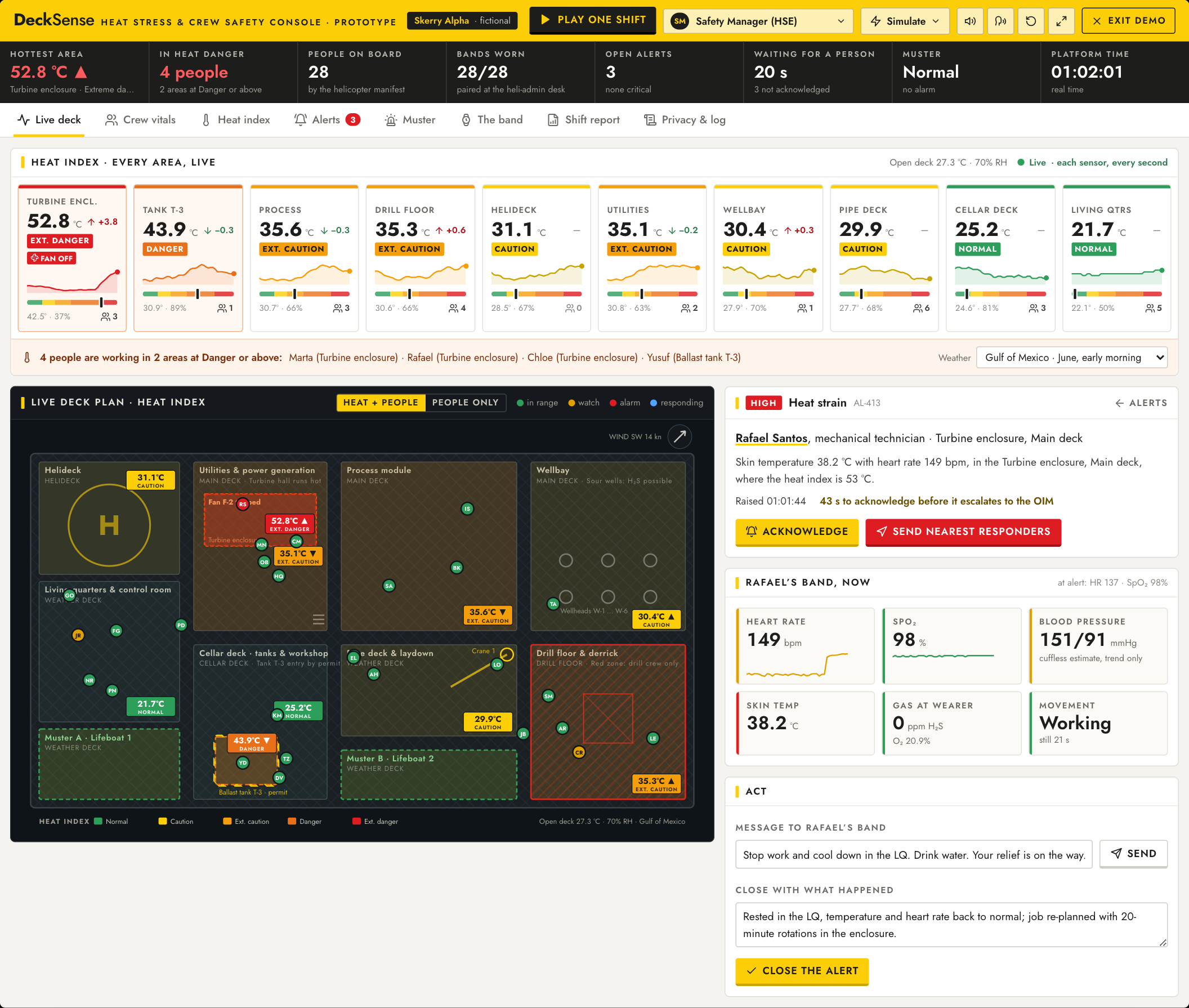
Every module on the platform has its own temperature and humidity sensor, and the console leads with its heat index, live, area by area, from Normal to Extreme danger, so a tripped ventilation fan shows up as a rising number before it shows up as a casualty. Each worker also wears a safety band. It knows where they are to about half a metre, reads their heart rate, blood oxygen, blood pressure trend and skin temperature, hears their gas monitor, and notices a fall. A console for the safety manager turns all of that into a live plan of the platform, alerts with a clock on them, the nearest responders sent with one press, and a muster board that names the missing person and says where they are. This is a working prototype of that console, on an invented platform. It runs in your browser, and the guided run plays one shift and performs every step for real.
The problem
Minutes matter, and the first minutes are spent finding people.
People are spread over five decks.
A platform is a steel town stacked on legs: helideck, weather deck, main deck, cellar deck, drill floor. Much of the work is done alone or out of sight, behind equipment, in enclosures and in tanks.
The hazards that hurt people are known.
Hydrogen sulphide from sour wells, falls on stairs and from height, heat in turbine enclosures, people under crane loads, low oxygen in confined spaces. What is usually missing is not the rule, but knowing in time who is in the hazard and how they are.
Gas detectors know where the gas is, not who is in it.
Fixed fire-and-gas detection tells the control room that a module has gas. It does not tell them that Tunde is at wellhead four, nor that he has already walked out.
Muster finds out who is missing, not where they are.
Card readers and roll calls at the lifeboats show that 27 of 28 have arrived. The 28th is then searched for, deck by deck, while everyone waits in their survival suits.
The band
One band per person, worn for the whole shift.
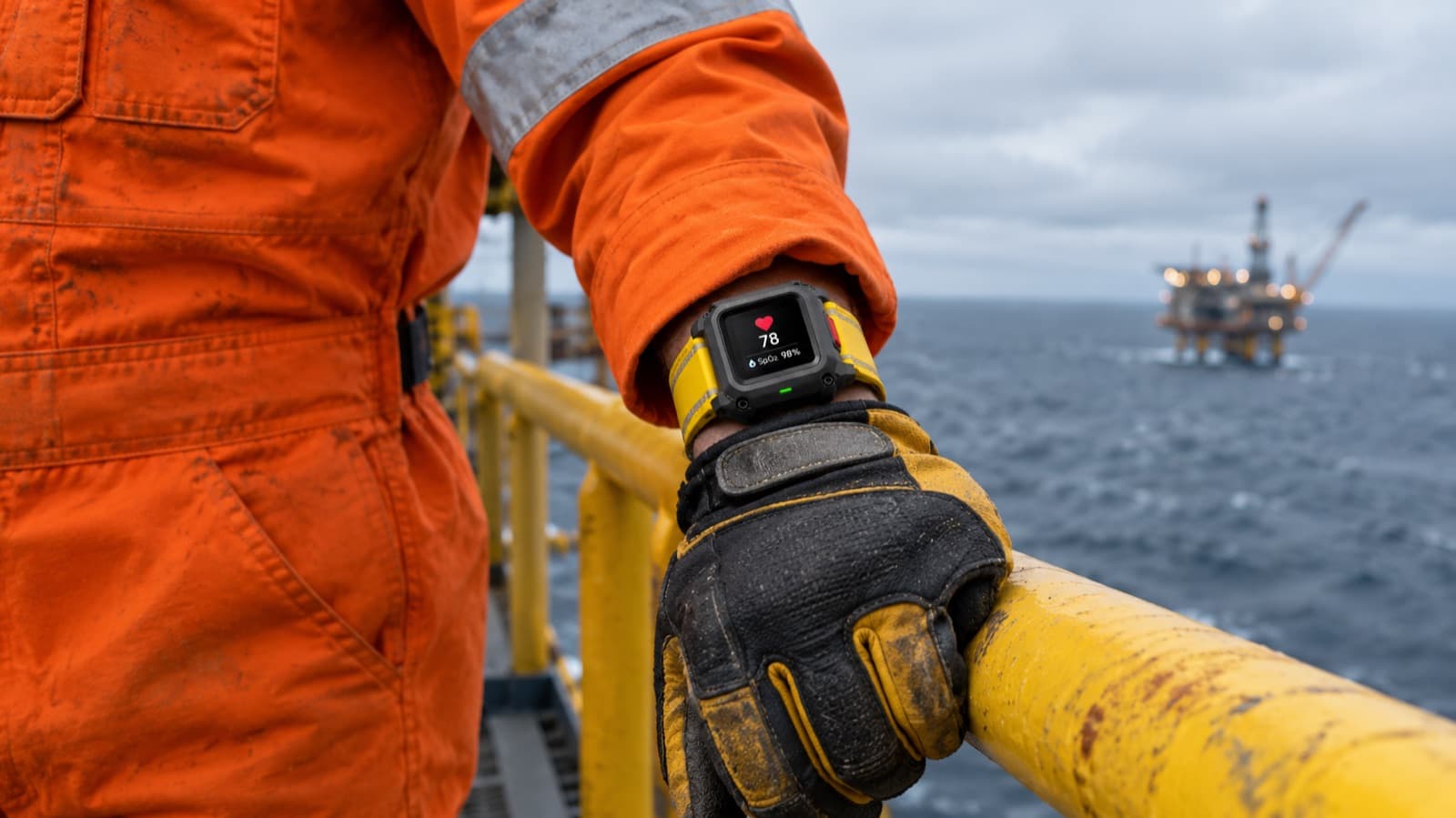
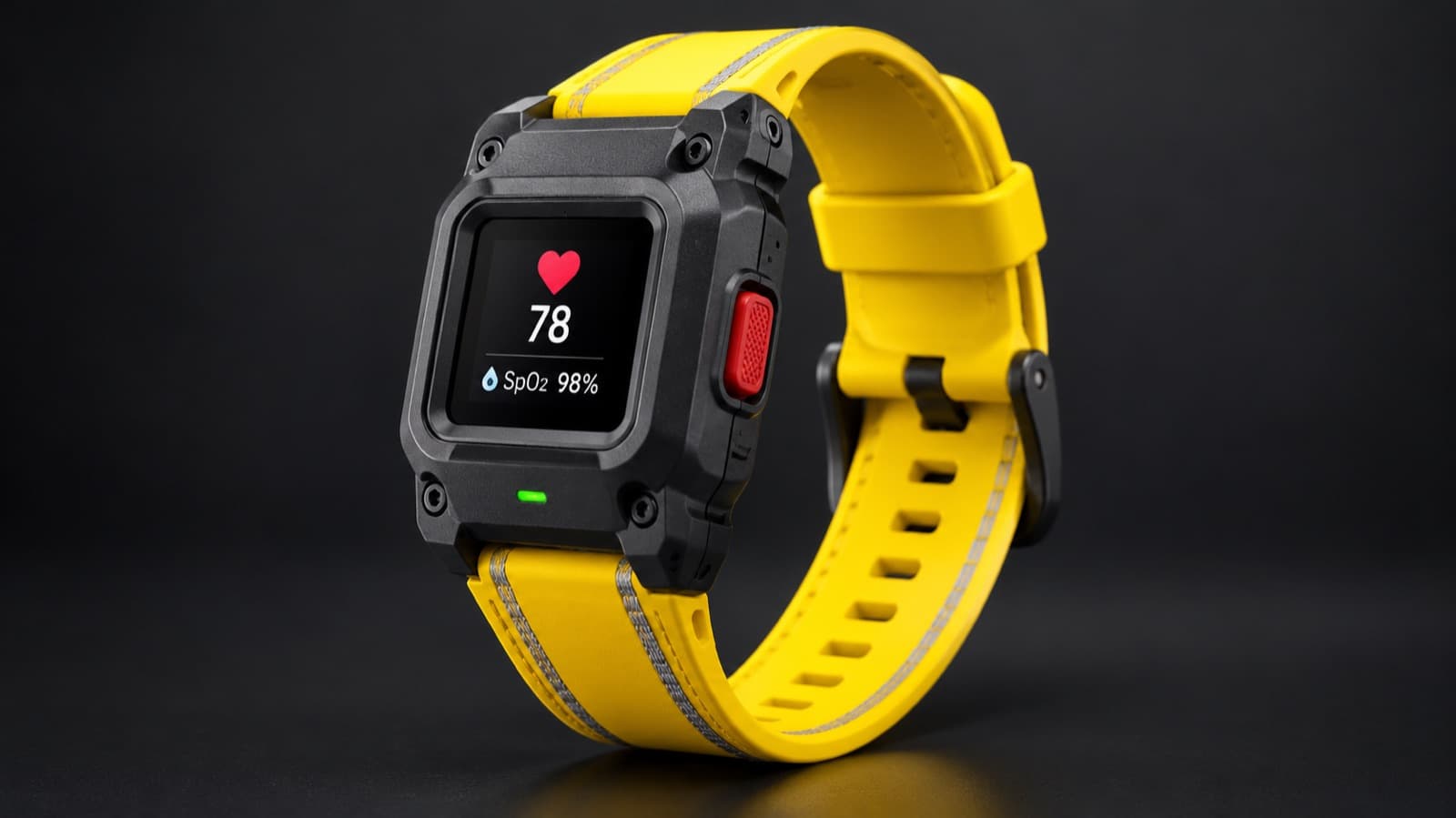
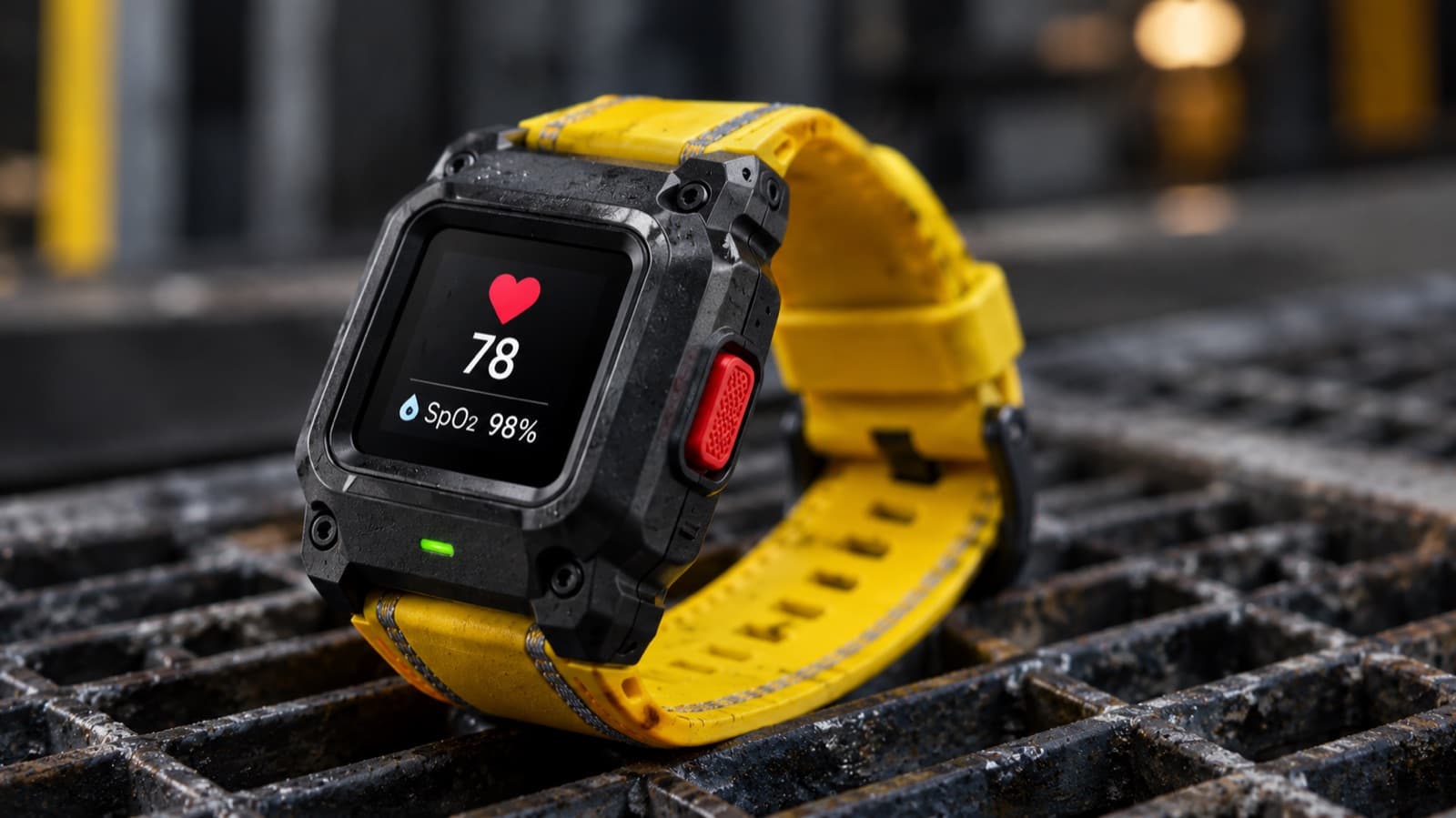
A concept, rendered for this page: a charcoal housing that can take a knock, a safety-yellow strap that shows up on deck, a screen that can be read in rain, and a red SOS key on the side.
Optical sensor
Heart rate and SpO₂ from the wrist, and a cuffless blood-pressure trend that is calibrated against a cuff at the medic’s and shown as an estimate.
Skin temperature
Read together with heart rate, the early sign of heat strain, long before someone collapses in an enclosure.
Accelerometer and barometer
A free fall followed by an impact and no movement is a man-down alarm; the barometer also says which deck the band is on.
Ultra-wideband and Bluetooth
Position to about half a metre from small anchors on each deck, so a dot on the plan is a place a responder can walk to.
The gas monitor already on the belt
H₂S and oxygen from the personal monitor each worker already carries, paired to the band, so a gas reading arrives with a name and a position.
SOS and haptics
Hold the red key for two seconds to call for help. Messages from the control room arrive as a vibration and one line of text.
The console
What the safety manager gets.
Built around one question: who needs help, where are they, and who is closest?
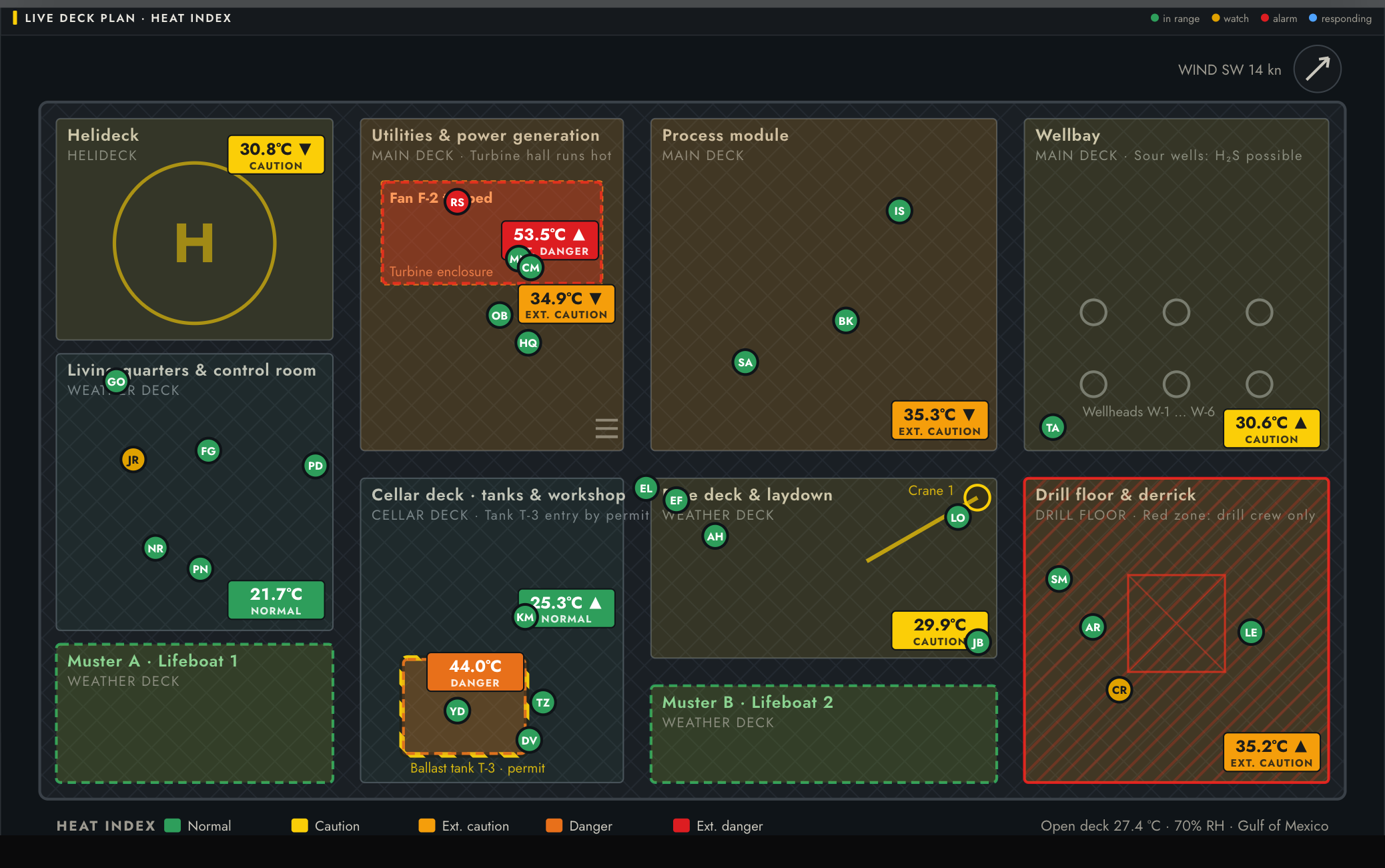
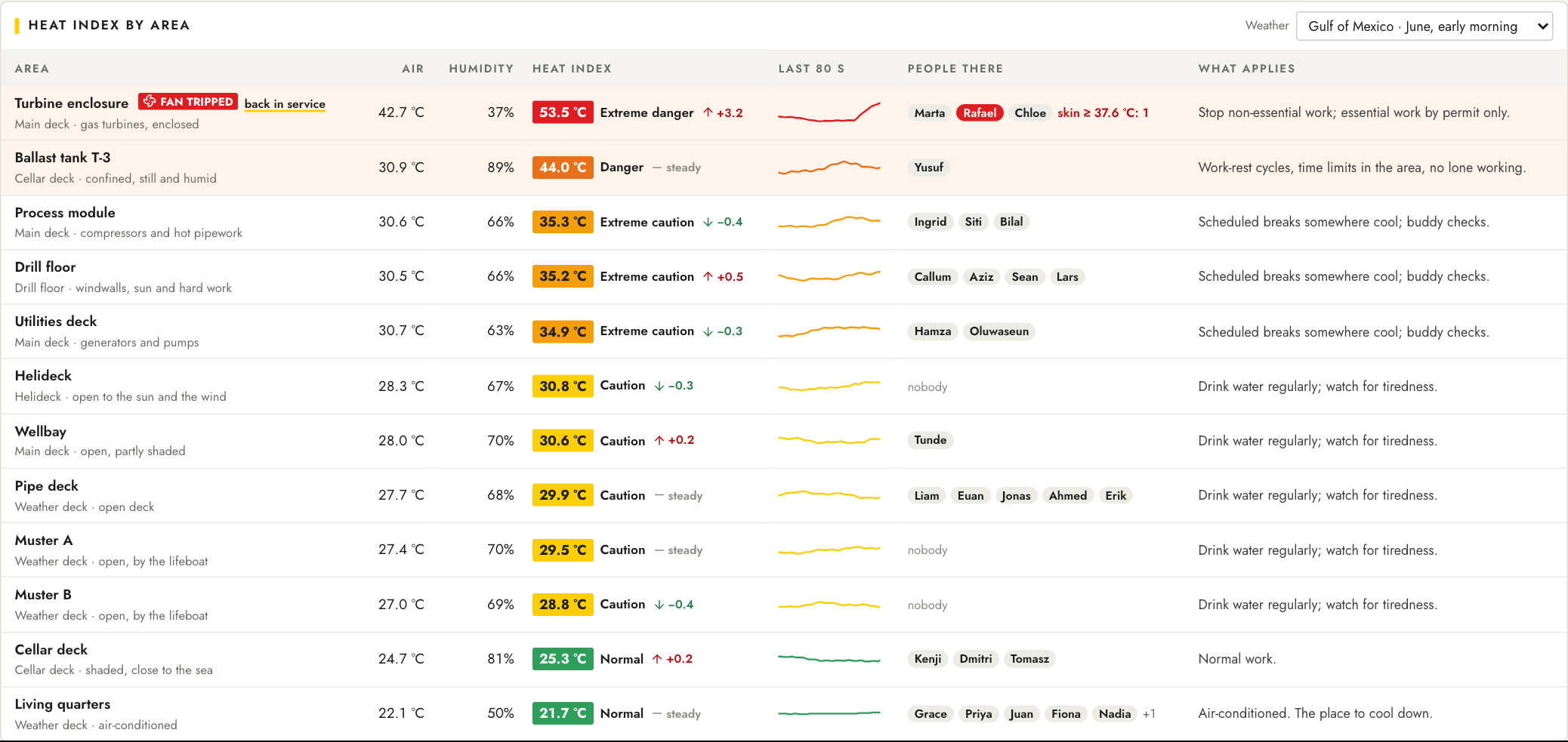
Heat index in every area, live.
Every module has a temperature and humidity sensor reporting each second. The console turns each pair into a heat index, grades it from Normal to Extreme danger and leads the dashboard with it: one live tile per area with its reading, which way it is moving and the last 80 seconds, the plan tinted by heat, and a count of who is working in Danger right now. Anyone in a Danger area gets a reminder on their band. A tripped ventilation fan shows up as a rising number before it shows up as a casualty.
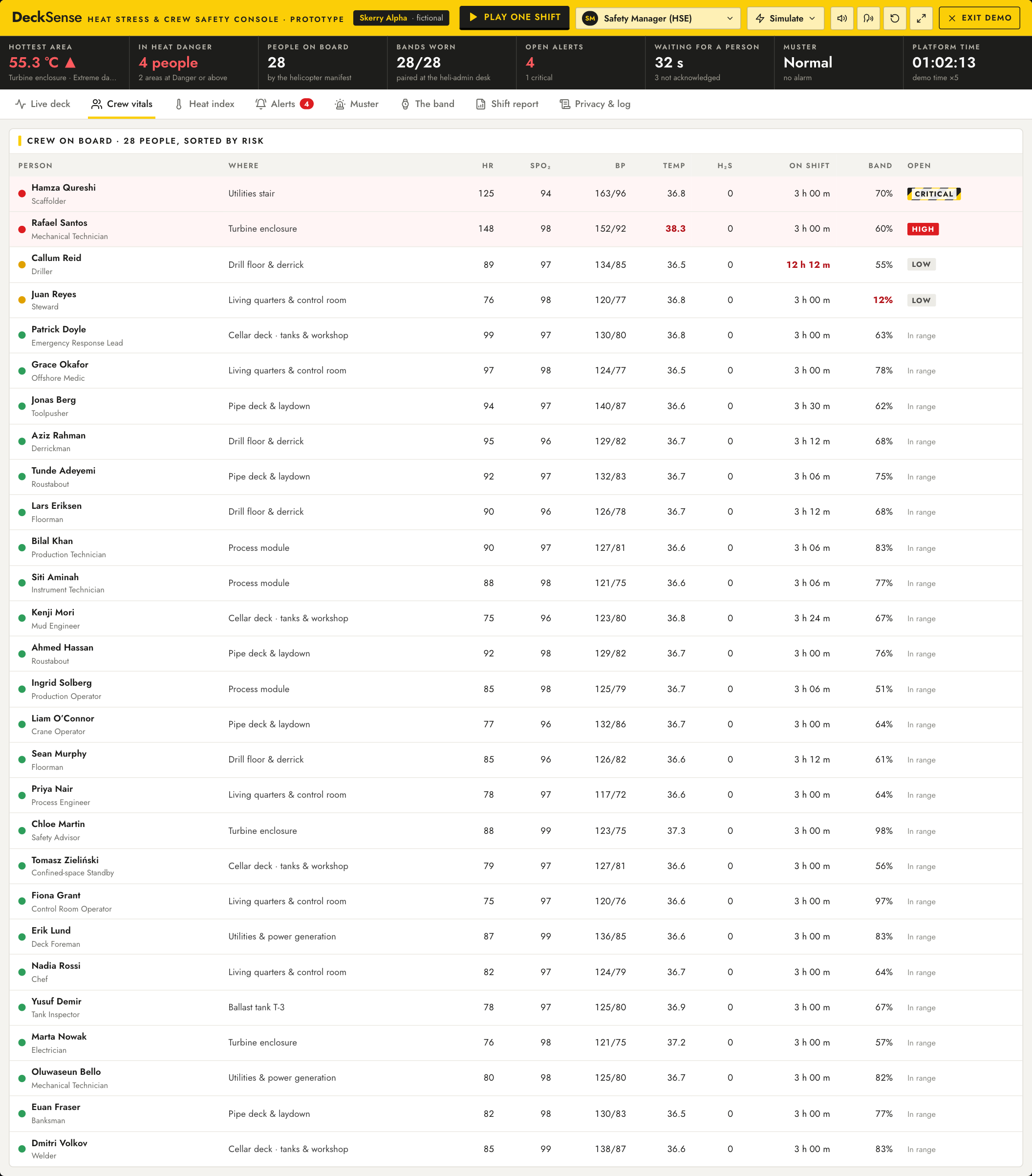
Every person on the plan, live.
One dot per person, coloured by state: in range, being watched, alarm, or a responder on the way. Tap a dot for the person, their readings, their permits and how long they have been on shift.
Rules turn readings into alerts.
Gas above the alarm level, a fall and no movement, oxygen low in a tank, heat strain, heart rate out of range, a restricted area entered without the permit, a band low on battery or off the wrist, hours on shift. The thresholds are the installation’s own, in configuration.
The band speaks first.
Before anybody in the control room has moved, the wearer is told what to do: leave upwind, step back from the load, help is coming. The crane operator is told to hold the lift.
A clock on every alert.
Critical alerts have thirty seconds to be acknowledged and high ones a minute; past that they escalate to the installation manager by themselves. Nothing can sit unseen in a queue.
The nearest people who can help.
One press sends the emergency response lead and the medic, chosen by distance on the plan, with the casualty’s name and exact place on their bands and their routes drawn on the screen.
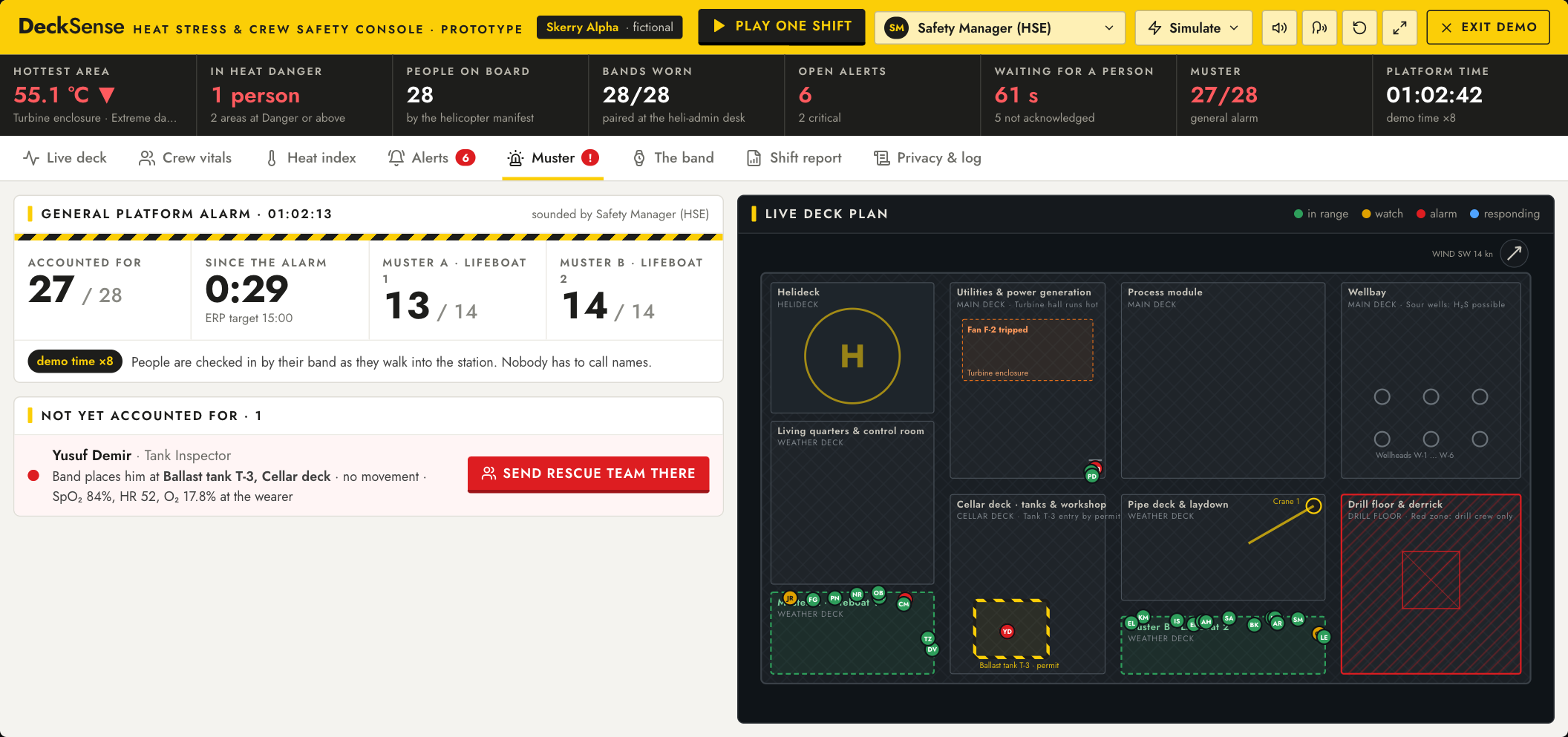
Muster with names and places.
On the general alarm, bands check people in as they walk into their station. The board counts up live and lists anyone not in, with where their band last placed them and whether their readings are normal.
Each role sees what it needs.
The safety manager sees readings, the medic sees full trends, the installation manager sees status. Health readings are not shown to anyone who does not need them.
The incident report writes itself.
Every reading that became an alert, every message to a wrist and every decision lands in an append-only log with a name and a time.
One shift
Five things go wrong. The guided run handles each one.
- 01
A fan trips in the turbine hall
The enclosure’s ventilation fan trips and its heat index climbs out of Danger towards Extreme danger, live on the dashboard. A technician inside has skin temperature and heart rate rising together. One message to one wrist: stop work, cool down, your relief is coming. With the fan back in service, the number comes down.
- 02
Gas at the wellbay
A roustabout’s monitor passes 10 ppm H₂S at a wellhead. His band tells him to leave upwind before the alert is even acknowledged; the safety manager barriers the wellbay on every band.
- 03
Man down on a stair
A scaffolder falls about two metres on the utilities stair and does not move. The nearest responders are sent with one press, and the medic takes over with the full trend of his heart rate and oxygen.
- 04
A man under the load
The crane is lifting drill pipe and a roustabout walks into the exclusion zone. Both bands buzz; the crane operator holds the lift. The software never touches the crane.
- 05
Muster, and the missing 28th
On the general alarm 27 of 28 are checked in by their bands within minutes. The 28th is still in a ballast tank, not moving, with low oxygen at the wearer. The rescue team goes straight to the tank instead of searching five decks.
Trust
Health data, handled like health data.
A band on every wrist only works if the people wearing it trust what it is for.
For safety only
Never for performance, attendance or discipline. That is written into the pilot agreement, not left to policy.
Each role sees what it needs
Readings to the safety manager and the medic; status to the installation manager; alerts and outcomes, not readings, to shore.
Kept briefly
Readings are deleted after 30 days. An alert’s record is kept as an incident record.
The wearer sees it too
Every worker can see their own data, and the band shows them every message the control room sent.
Agreed first
The purpose, the data and the access rules are agreed with the workforce and its safety representatives before the first band is handed out.
It tells people, it never acts
The console never stops, starts or moves equipment. The crane operator holds the lift; the production team isolates the leak.
Architecture
How it would be built.
On the platform first
Bands talk to anchors and certified gateways on each deck, and the alarm server runs on an edge server in the platform’s own equipment room. If the link to shore drops, alerts, muster and messages keep working.
Read from the systems already there
The fire-and-gas system, the general alarm, the permit-to-work system and the personnel-on-board list from the helicopter manifest are read, not replaced. The console adds people to the picture those systems already draw.
Rules before any model
Thresholds and geofences are deterministic and configured by the installation, with a logged approver for every change. Any learning on top, such as a fatigue or heat-strain score, ranks attention and never silences an alarm.
Hardware for hazardous areas
Anything worn on the deck has to be certified for the zone it enters (ATEX / IECEx, typically Zone 1), last a twelve-hour shift and live on a charging rack at the heli-admin desk between shifts.
Onshore sees status
The onshore duty team gets alerts, muster status and the incident record, not a stream of health readings.
Pilot
Thirteen weeks, one installation, then a decision.
Agree and install
Agree the purpose, the data and who sees what with the workforce and its safety representatives. Anchors and gateways on one installation; thresholds set with the medic and the HSE lead.
One crew rotation, side by side
Bands worn by volunteers on one rotation, the console running next to the existing systems. Drills include a man-down test and a full muster.
Measure and decide
Time to acknowledge, time to a responder on scene and muster time against the installation’s own drill records; false alarms per shift; wear rate; and what the crew thought of it. Then extend, change or stop.
Questions
Wearable safety offshore, answered.
What is a connected-worker safety band?
A wrist-worn device that reports the wearer’s position, movement and basic vital signs, and can raise an alarm, so a control room can see who is where and whether they are all right. On an offshore platform it is paired with the personal gas monitor the worker already carries, and it receives short messages from the control room as a vibration and a line of text.
How does man-down detection work?
The band’s accelerometer looks for a free fall followed by an impact, and then for no movement. Its barometer measures the height of the drop. If the wearer does not move for a few seconds after a fall, the band raises a critical alert with their position and readings, and tells the wearer help is being called.
Can a wearable be used in hazardous areas on a rig?
Only if it is certified for them. Equipment worn in areas where flammable gas may be present has to be intrinsically safe and certified under ATEX or IECEx for the zone, typically Zone 1 on a process deck. That is a hardware requirement any pilot starts from.
How does the band help at muster?
When the general alarm sounds, every band vibrates with its wearer’s muster station, and people are checked in automatically as they walk into it. The board lists anyone not yet in by name, with where their band last placed them, how long since they moved and whether their readings are normal, so a search goes straight to them.
How does the console show heat stress on a rig?
Each module has a temperature and humidity sensor reporting every second, and the console works out a heat index for it with the US National Weather Service formula, then grades it in the NWS bands: Caution from about 27 °C, Extreme caution from 32 °C, Danger from 39 °C and Extreme danger from 52 °C. The dashboard leads with one live tile per area and a count of who is working in Danger, the plan is tinted by band, and anyone working in a Danger area gets a reminder on their band. The installation’s own heat-stress plan, which may use WBGT instead, sets the actual work-rest cycles. Separately, each worker’s skin temperature and heart rate raise a heat-strain alert wherever they are.
Is the data used to monitor performance?
It should not be, and in this design it is not. Readings are used for safety only, kept for 30 days and then deleted, and shown only to the roles that need them: the medic sees trends, the installation manager sees status. Wearing the band is agreed with the workforce and its safety representatives before a pilot starts.
What happens if the link to shore goes down?
Nothing changes on the platform. The alarm server, the muster board and the messages to bands run on an edge server on the installation; the onshore view simply catches up when the link returns.
Scope
What this is, and what it is not.
- It is a prototype I built on my own time to show how such a system could work. It is not a deployed or certified product and it is not affiliated with any operator.
- Skerry Alpha is invented, and so are every person, reading, permit and event in the demo. The band is a concept render generated for this page.
- The simulation runs in your browser. Nothing is collected and nothing leaves it.
- Thresholds in the demo are typical settings shown for illustration; an installation sets its own with its medic and its HSE function.
- Wrist sensors are good at trends and poor at clinical precision, cuffless blood pressure above all. The console treats them as early warning, not diagnosis.